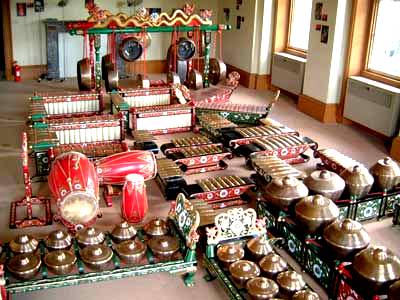
The location is Central Java, Indonesia The function is accompaniment for a wayang (traditional shadow-puppet drama) The Genre is Patalon (overture), from Act I of the play
Medium: Gamelan orchestra, consisting of: Soft metallophones (gender, slenthem) Loud metallophones (demung, saron, peking) Various gongs (kempul, bonang, kenong) Drums (kendang) Wooden xylophone (gambang) Voice (pesindèn)
CHARACTERISTICS: Pentatonic melodies in sléndro scale, played in patet(mode) manyura, colotomic (cyclical) structure, polyrhythmic
STRUCTURE: 5 distinct sections Ayak-Ayakan Srepegan Palaran Pucung Srepegan Banyumasan Sampak sléndro manyura
The piece consists of pentatonic melodic patterns and organized rhythmic cycles, dstinctive timbre of metallic percussion instruments, linear movement of music, with vertical percussive punctuations, vocal embellishments above instrumental melodic patterns, flexible tempos, as work progresses from one section to another.
Introduction to Ayak-Ayakan—highest-sounding metallophone (peking) strikes twice for every note of the melodic framework; voice enters shortly after beginning; singer elaborates on the main melody, punctuated by gongs. Drummer cues the transition to the next section and the tempo increases.
Srepegan—drummer cues transition to next section; first 4 notes of Ayak-Ayakan played loudly, moving to the srepagan; kenongnow plays every note of melodic framework, lending tension to the performance; voice continues elaborations.
Transitional cadence to Palaran Pucung. Palaran Pucung—played in soft style, featuring quiet instruments. Dramatic accent in song text, with sudden, dynamic leap following strike of small gong. Loud instruments (especially peking) are heard as dynamics grow, leading to return of srepegan. Srepegan Banyumasan (2 parts: loud and soft):
Loud style—a repeat of earlier srepegan; singer drops out during first line. Soft style—differs from earlier srepegan; small gong (kempul) drops out during first line.
Sampak—fast, insistent, repetitive melody; signals the end of the overture and the entrance of the dancers or puppets.
Final cadence (suwuk); slows down gradually; a silence is heard before the last note is held; final note in large gong, followed by other instruments in a loose note cluster (not played together).